
 +91 9152107263 | +91 22 3520 9600
 enquiry@aimscollegeofphysiotherapy.com | admin@aimscop.edu.in
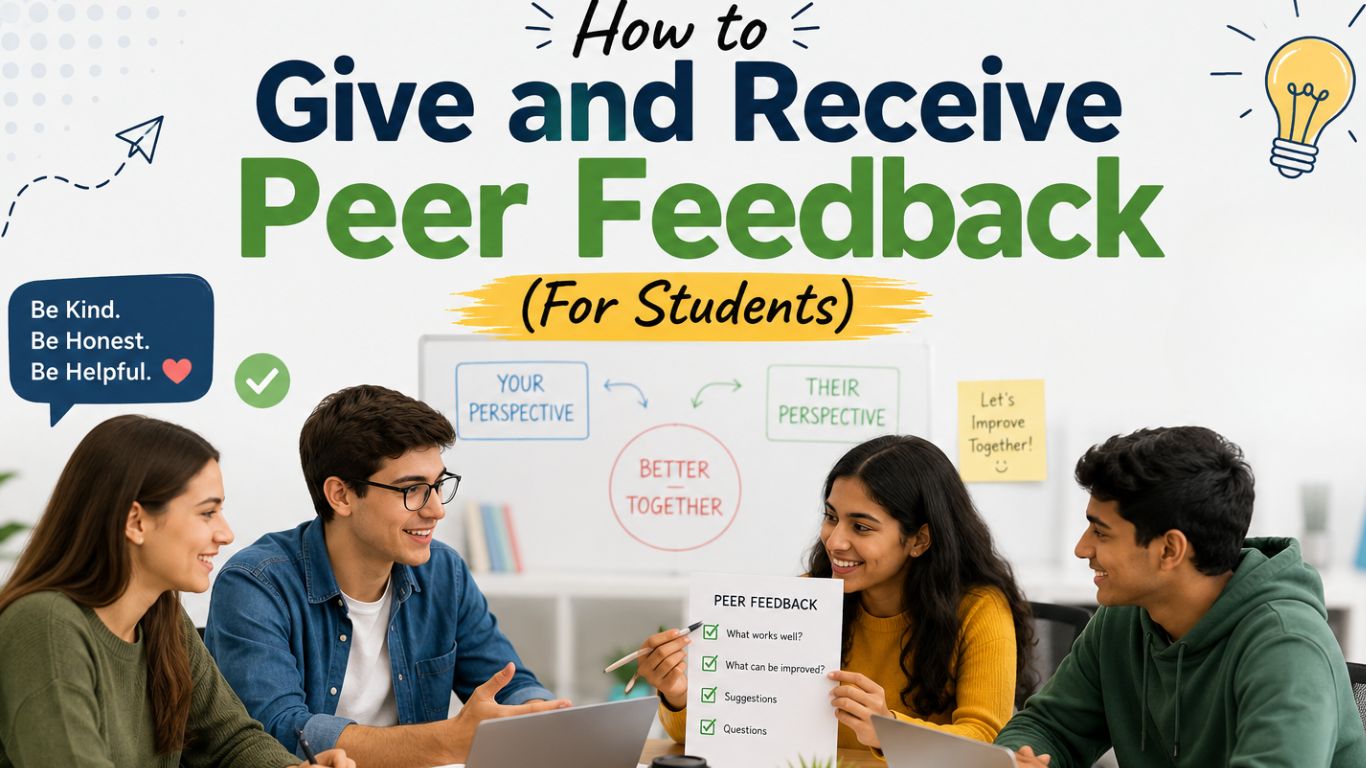
Introduction: Why Peer Feedback Matters
In seminars, journal clubs, and group projects, feedback is one of the fastest ways to improve your work—if you know how to give it and receive it well. Many students either avoid honest feedback (to “be nice”) or give harsh comments that damage confidence. On the other side, some students feel personally attacked by even small suggestions.
This guide will help you develop professional peer-review skills: how to give constructive feedback that actually helps, and how to receive feedback without feeling discouraged.
Table of Contents
- Introduction: Why Peer Feedback Matters
- Part 1: How to Give Constructive Feedback
- Part 2: How to Receive Feedback Professionally
- Part 3: Peer Review in Group Discussions or Journal Clubs
- Peer Review Checklist: Before, During, and After
- Final Thoughts on Giving and Receiving Peer Feedback
Part 1: How to Give Constructive Feedback
1. Start with a Positive Note
Begin by pointing out something that genuinely works well.
- Better:
- “Your methodology is really clear; I like how you structured the experiment.”
- Avoid:
- “This section is confusing.” (too vague and negative)
A positive start makes the other person more open to hearing your suggestions.
2. Be Specific and Evidence-Based
Vague criticism is not useful.
- Weak: “Your argument is weak.”
- Better: “Your claim in the second paragraph needs more support—maybe add a citation from Smith (2022).”
Always link your comment to a concrete part of the work (page, slide, section).
3. Use the “Sandwich Method”
Structure your feedback like this:
- Praise – What worked well?
- Critique – What needs improvement (with specifics)?
- Encouragement – Why it’s worth improving / how it can become strong.
Example:
“Your literature review covers the key studies really well (praise), but some of the sources are a bit outdated—adding 2–3 recent papers from the last five years would strengthen it (critique). The topic is very relevant; with a few updates this could be a very solid review (encouragement).”
4. Focus on the Work, Not the Person
Direct your comments to the assignment or presentation, not the student’s character.
- Avoid: “You didn’t explain this well.”
- Better: “This section would be clearer if you added an example or a diagram.”
This helps maintain a professional atmosphere and protects relationships.
5. Suggest Solutions, Not Just Problems
Pointing out flaws without ideas for improvement can feel demotivating.
- Weak: “The conclusion is rushed.”
- Better: “The conclusion feels a bit short—maybe add one sentence that links back to your main research question.”
Even small, practical suggestions are valuable.
6. Use a Simple Feedback Template
For written peer review, you can use a quick table like this:
| Section | Strength | Suggestion |
|---|---|---|
| Introduction | Clear research gap identified | Add a stronger hook to engage readers |
| Methodology | Procedures well described | Briefly justify the sample size choice |
This keeps feedback focused and balanced.
Part 2: How to Receive Feedback Professionally
Learning to receive feedback is just as important as learning to give it. It is a key skill in academic life, clinical work, and research.
1. Listen First, React Later
When someone is giving feedback:
- Do not interrupt or immediately defend yourself.
- Take notes while they speak.
- Ask clarifying questions only after they finish.
Example questions:
- “Which part felt unclear to you?”
- “Can you show me the slide/paragraph you mean?”
2. Separate Your Work from Your Ego
Feedback is about the work, not your worth as a person or student.
- Unhelpful reaction: “They just don’t understand my genius.”
- Better mindset: “What can I learn from this to improve the next version?”
Remember: even excellent researchers revise their work many times.
3. Look for Patterns
If multiple people point out the same issue, it is probably real.
- If three peers say, “Your slides are hard to read,” then font size or design likely needs changing.
- Do not dismiss repeated feedback as “just their opinion.”
Use repeated comments as a priority list for revision.
4. Ask Follow-Up Questions
Good follow-up questions include:
- “Can you suggest how I could present this part more clearly?”
- “Do you know any article or example I can look at to improve this section?”
This turns feedback into a mini-coaching session.
5. Decide What to Use (You Don’t Have to Accept Everything)
Not every piece of feedback must be implemented.
- Some suggestions will conflict with each other; some may not fit your goals.
- Thank the reviewer anyway, but choose changes that genuinely strengthen your work and keep your voice.
A good rule: If a comment aligns with your objectives, improves clarity, or corrects a factual issue, it is usually worth applying.
Part 3: Peer Review in Group Discussions or Journal Clubs
When feedback happens in a group (seminar, journal club, group project):
Do:
- Take turns so everyone gets a chance to speak.
- Refer to slide numbers or page numbers for clarity.
- Summarize key takeaways at the end (“So main points to improve are…”).
Don’t:
- Dominate the discussion or talk over others.
- Make comments personal.
- Ignore feedback you disagree with without considering it seriously.
Peer review should feel like a team improving the work, not like an attack.
Peer Review Checklist: Before, During, and After
Before you give feedback:
- Have I read or listened carefully?
- Do I have at least one genuine strength to mention?
- Can I point to specific places that need work?
While giving feedback:
- Am I focusing on the work, not the person?
- Am I being specific and constructive?
- Am I suggesting solutions, not just pointing out problems?
While receiving feedback:
- Am I listening fully without interrupting?
- Am I taking notes instead of defending?
- Am I looking for patterns in what multiple people say?
Final Thoughts on Giving and Receiving Peer Feedback
Good peer review is not about being “too nice” or “brutally honest.” It is about helping each other improve. The best students learn to give feedback generously and receive it gracefully. Those are exactly the skills that will serve you later in research teams, clinical departments, and any professional environment where collaboration matters.