
 +91 9152107263 | +91 22 3520 9600
 enquiry@aimscollegeofphysiotherapy.com | admin@aimscop.edu.in
Dr Shruti Patil
(For Academic Research and Seminar Presentations)
Table of Contents
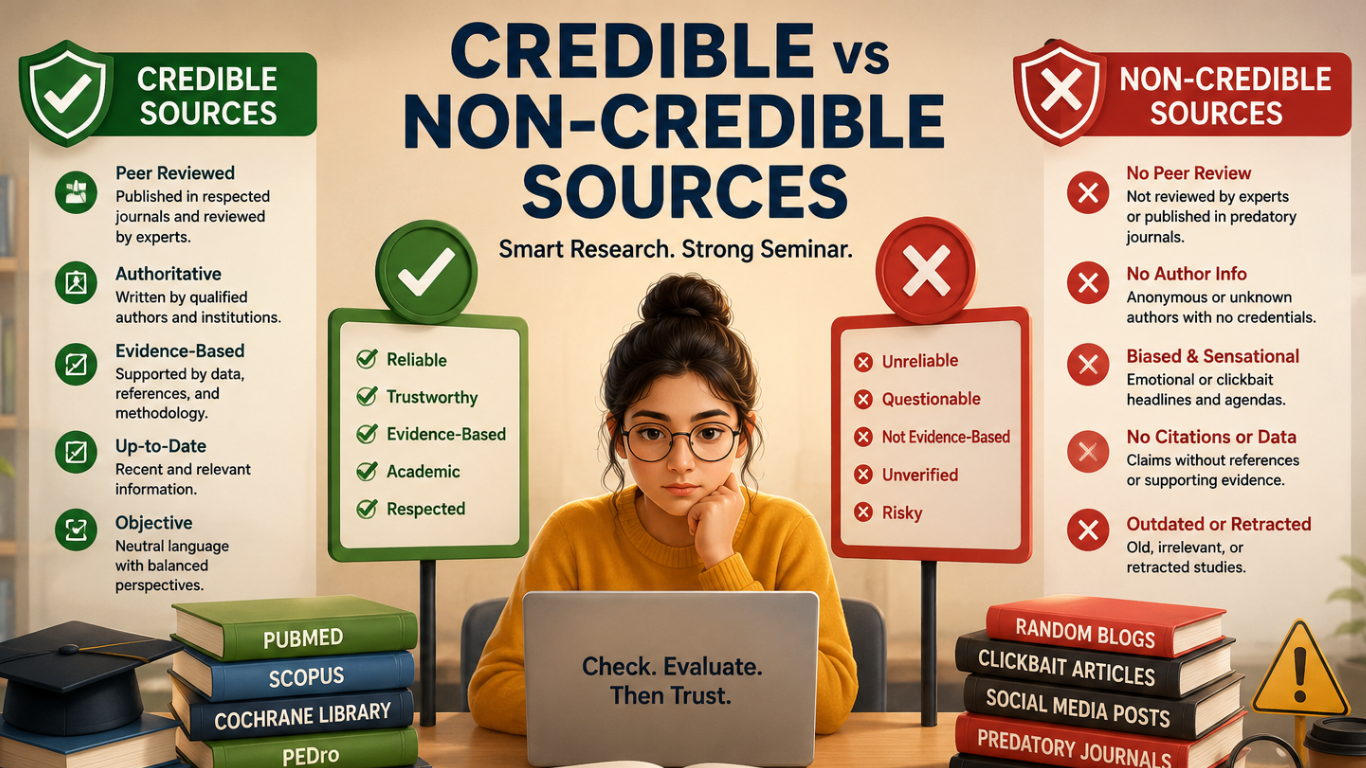
- Red Flags of Non-Credible Sources
- Lack of Peer Review
- No Clear Author Credentials
- Biased, Sensational, or Emotional Language
- Missing Citations or Data
- Outdated or Retracted Research
- A Simple Framework: The CRAAP Test
- Cross-Check Before You Trust
- Use the Right Databases for Your Field
- Spotting Predatory Journals
- When in Doubt, Ask
- Final Takeaway
Not all sources are created equal. If you use weak or unreliable references in your seminar or assignment, your credibility can collapse in seconds—especially in front of experienced guides and professors. Learning to separate credible sources from non-credible ones is a core academic skill.
This guide walks you through practical checks you can apply to any article, website, or paper you plan to cite.
1. Red Flags of Non-Credible Sources
a) Lack of Peer Review
Non-credible examples:
Random blogs or opinion sites.
Wikipedia as a primary source.
Self-published books with no editorial process.
Predatory journals that publish anything for a fee.
Credible examples:
Peer-reviewed journals (e.g., those indexed in PubMed, Scopus, Web of Science).
University press books.
Reports from reputable institutions (WHO, NIH, government agencies).
Quick check:
Look up the journal in Scimago Journal Rank (SJR) or Journal Citation Reports (JIF) to confirm quality.
b) No Clear Author Credentials
Non-credible examples:
Anonymous authors.
“Guest contributors” with no qualifications listed.
Social media “experts” with no research background.
Credible examples:
Authors with clear academic or clinical affiliations (universities, hospitals, research institutes).
Researchers who have a Google Scholar profile or are cited by other credible papers.
Quick check:
Search the author’s name plus “affiliation” or “Google Scholar” to see their publication record.
c) Biased, Sensational, or Emotional Language
Non-credible examples:
Headlines like “BREAKTHROUGH CURE” or “Shocking secret doctors don’t want you to know.”
Articles that clearly push a political, commercial, or ideological agenda without acknowledging bias.
Credible examples:
Neutral, evidence-based language.
Clear description of methodology (e.g., “double-blind randomized controlled trial with 150 participants”).
Conclusions that are cautious and supported by data.
d) Missing Citations or Data
Non-credible examples:
Claims like “Studies show…” with no references.
Internal company “reports” that are not publicly available.
Infographics with numbers but no source.
Credible examples:
Properly formatted references (APA, Vancouver, MLA, etc.).
Links or references to raw data, supplementary files, or trial registrations where appropriate.
Quick check:
Can you trace a claim back to an actual study or dataset?
If not, treat it as unreliable.
e) Outdated or Retracted Research
Non-credible examples:
Very old studies (e.g., more than 10–15 years) in fast-moving fields like AI, medicine, or rehabilitation, unless they are classics.
Papers that have been formally retracted.
Credible examples:
Recent studies (last 5 years) for rapidly evolving topics.
Classic landmark trials used to provide historical context, not as the only evidence.
Quick check:
Always check the publication year.
If the paper is controversial, search “[paper title] retracted” or check Retraction Watch.
2. A Simple Framework: The CRAAP Test
You can remember source evaluation using the CRAAP test:
Currency – Is the information up to date for your field?
Relevance – Does it directly address your research question?
Authority – Is the author or organization qualified and reputable?
Accuracy – Is the information supported by evidence and references?
Purpose – Is the content primarily to inform, or to sell/influence?
If a source fails on multiple CRAAP dimensions, do not use it for academic work.
3. Cross-Check Before You Trust
Do not rely on a single paper or website to support a major claim.
If only one obscure study supports a strong claim, be cautious.
If multiple independent studies from credible journals agree, you can be more confident.
Practical habit:
For any important point in your seminar, try to confirm it from at least two independent credible sources.
4. Use the Right Databases for Your Field
When in doubt, start from recognized academic databases rather than general Google.
| Field | Credible Databases and Sources |
|---|---|
| Medicine and rehab | PubMed, Cochrane Library, PEDro, CINAHL |
| General science | Scopus, Web of Science, Google Scholar |
| Physiotherapy | PEDro, PubMed, specific specialty journals |
This small shift—from open web to curated databases—dramatically improves the average quality of your sources.
5. Spotting Predatory Journals
Predatory journals look like real journals but accept almost anything for a fee and do not provide proper peer review.
Warning signs:
The journal is not indexed in Scopus, PubMed, or other major databases.
The website has poor grammar, vague peer-review descriptions, or very short submission-to-publication times.
The editorial board lists people you cannot verify or who publicly deny involvement.
Quick checks:
Search the journal name plus “predatory” or “Beall’s list”.
Ask a librarian or your guide if you are unsure.
6. When in Doubt, Ask
If you are not sure whether a source is acceptable:
Ask your guide, supervisor, or librarian before you build your whole seminar around it.
It is better to drop a questionable paper early than to have your presentation challenged on basic credibility.
Final Takeaway
Your seminar is only as strong as the sources behind it. Learning to distinguish credible from non-credible sources protects your reputation, strengthens your arguments, and shows your teachers that you understand how real academic work is done. Over time, this habit will also make you faster and more confident when you read research.